“The greatest leaders do not choose the threshold that changes history. They choose how they will respond once they arrive there.”
There are moments in history when tragedy produces despair.
There are far fewer moments when tragedy produces transformation.
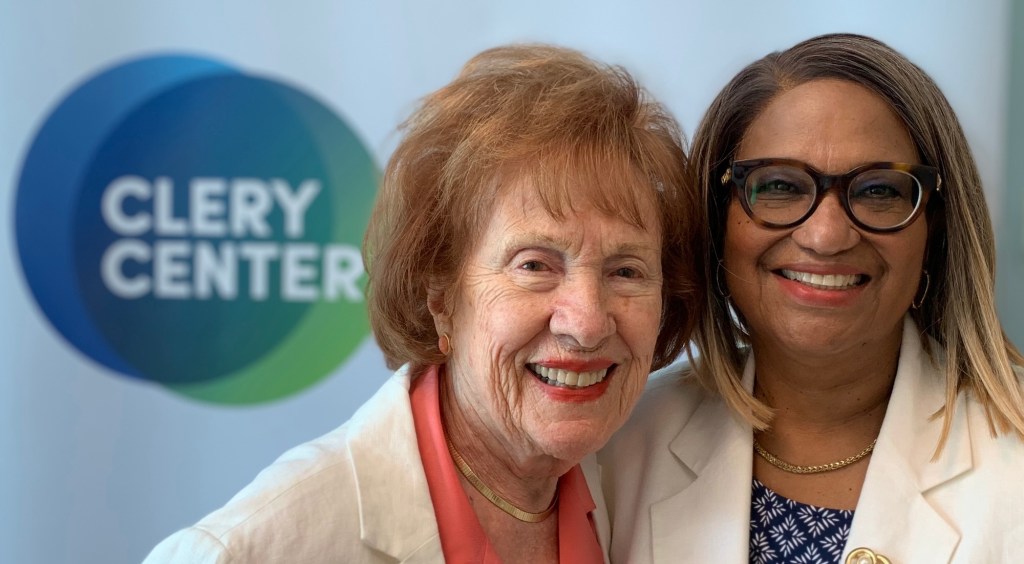
The life and leadership of Connie Clery, who died at age 95 on June 23, belongs firmly in the second category. I had the honor of serving with Connie on the Board of Directors of Clery Center since 2020, with four years as Chair of the Board from 2021 to 2025.
Following the 1986 murder of her daughter, Jeanne Clery, in her residence hall at Lehigh University, Connie and her husband, Howard Clery, faced a decision no parent should ever confront. They could retreat into private grief, or they could dedicate themselves to ensuring that no other family would experience what theirs had endured.
They chose leadership.
Their decision ultimately transformed higher education in America through what became the Jeanne Clery Disclosure of Campus Security Policy and Campus Crime Statistics Act—known today simply as the Clery Act.
Decades later, Connie’s leadership extended far beyond passage of a federal law. She helped build an institution dedicated to campus safety, served for years as Executive Director of the Clery Center, continued as an active member of its Board of Directors, and remained engaged in its mission until her death at age ninety-five.
Viewed through The Threshold Framework™, Connie Clery’s life illustrates what transformational leadership looks like when purpose triumphs over pain.

The Threshold
Every transformational leader encounters a defining threshold.
For George Washington, it was the uncertain days before Valley Forge.
For Connie Clery, it began with a knock on the door announcing that her daughter would never come home.
The threshold she crossed was not one she chose.
It was one history placed before her.
The question became:
Would grief define her—or would purpose redefine grief?
Her answer changed America.
Pillar I
Clarity Under Pressure
The first principle of The Threshold Framework asks one essential question:
What must not fail?
Connie Clery understood immediately that the issue extended far beyond her own family’s loss.
Students and parents across America lacked information that could help them make informed decisions about campus safety.
Many colleges and universities were not publicly disclosing crime information.
Without transparency, there could be no accountability.
Without accountability, dangerous conditions could continue unchecked.
Connie never lost sight of that objective.
Her mission was not vengeance.
It was prevention.
That clarity allowed her to persevere through years of advocacy, political negotiations, public skepticism, and institutional resistance.
Great leaders simplify complexity.
Connie’s message remained remarkably clear:
Parents deserve to know. Students deserve to know. Institutions must tell the truth.
That clarity ultimately became federal law.
Pillar II
Morale Is Strategy
Advocacy is emotionally exhausting.
Legislation moves slowly.
Victories are uncertain.
Opposition is inevitable.
Connie Clery learned that sustaining a movement required more than compelling facts.
It required sustaining people.
Throughout the decades, Connie became more than an advocate.
She became the emotional center of a growing community of families whose children had died in preventable campus tragedies.
When new families arrived carrying unimaginable grief, they found someone who understood.
She offered compassion without surrendering determination.
Hope without minimizing pain.
Purpose without forgetting loss.
Those qualities became foundational to the culture of the Clery Center.
As Executive Director, Connie understood something many leaders overlook:
Organizations are sustained not simply by strategy, but by shared purpose.
Morale is not soft leadership.
It is operational leadership.
Every family she encouraged, every survivor she comforted, every volunteer she inspired strengthened the movement itself.
Pillar III
Geography Matters
The Threshold Framework teaches that leaders must understand their terrain.
For Connie Clery, that terrain was extraordinarily complex.
It included Congress.
Federal agencies.
College presidents.
Campus police.
Student affairs professionals.
Parents.
Victims’ families.
National media.
Higher education associations.
Rather than attacking higher education, Connie chose to improve it.
She built relationships.
She educated rather than condemned.
She understood that lasting change required institutions to become partners in reform rather than permanent adversaries.
That strategic understanding ultimately led to something even more enduring than legislation.
It led to the creation of the Clery Center, an organization dedicated not merely to enforcing compliance, but to improving campus safety through education, collaboration, training, and leadership.
The Clery Center became the institutional embodiment of Connie’s vision.
Good leaders solve today’s problem.
Great leaders build institutions capable of solving tomorrow’s problems.
Pillar IV
Delay Is a Decision
Few things are easier than assuming someone else will solve the problem.
Connie Clery refused.
She understood that every year without reform meant another class of students entering campuses without complete information about crime and safety.
Delay would cost lives.
The campaign to enact the Clery Act required years of persistence.
There were setbacks.
Legislative delays.
Political obstacles.
Institutional resistance.
Yet Connie never accepted delay as an excuse to stop.
The Threshold Framework teaches that waiting is itself a decision.
Connie chose action.
Again.
And again.
And again.
Until Congress acted.
Her persistence demonstrates one of leadership’s greatest truths:
Extraordinary change often belongs not to the loudest advocate but to the one who refuses to quit.
Pillar V
Symbolic Leadership
Few individuals become symbols.
Connie Clery did.
Over time, she came to represent integrity, courage, and moral persistence.
Her leadership communicated long before she spoke.
Students recognized her.
Campus administrators respected her.
Members of Congress listened to her.
Victims’ families trusted her.
The Clery Center itself became symbolic leadership in action.
Its existence reminds colleges and universities that compliance is not simply about regulations.
It is about protecting human lives.
Even after stepping down as Executive Director, Connie continued serving on the Board of Directors.
She remained engaged because leadership is not a position.
It is a lifelong commitment.
Until her death at ninety-five years old, she continued shaping the organization she had helped build.
That is symbolic leadership at its highest level.
The Institutional Legacy
Most legislation eventually fades into history books.
The Clery Act became something different.
Every year, thousands of colleges and universities publish Annual Security Reports because of Connie Clery’s leadership.
Millions of students and families make enrollment decisions using information that previously would have remained hidden.
Campus safety professionals receive training.
Institutions improve emergency notification systems.
Crime statistics are publicly reported.
Lives are protected.
These are not simply compliance requirements.
They are expressions of one woman’s decision that tragedy should produce transparency rather than silence.
Rest in peace, Connie. You deserve it.


Leave a Reply