
Part 4 of the Leadership at the Threshold Philadelphia Campaign Series
On October 4, 1777, General George Washington made one of the boldest decisions of the Philadelphia Campaign of the Revolutionary War.
He attacked.
Think about the circumstances.
The Continental Army had lost at the Battle of Brandywine on September 11.
Anthony Wayne’s troops had endured the devastating surprise from the British Army at the Paoli Massacre on September 20.
The British had occupied Philadelphia on September 26, entering and taking the new nation’s capital and most populous city of 40,000 residents with nary a shot fired.
The obvious response might have been caution.
Washington chose something else.
He attempted an ambitious attack on British forces at Germantown.
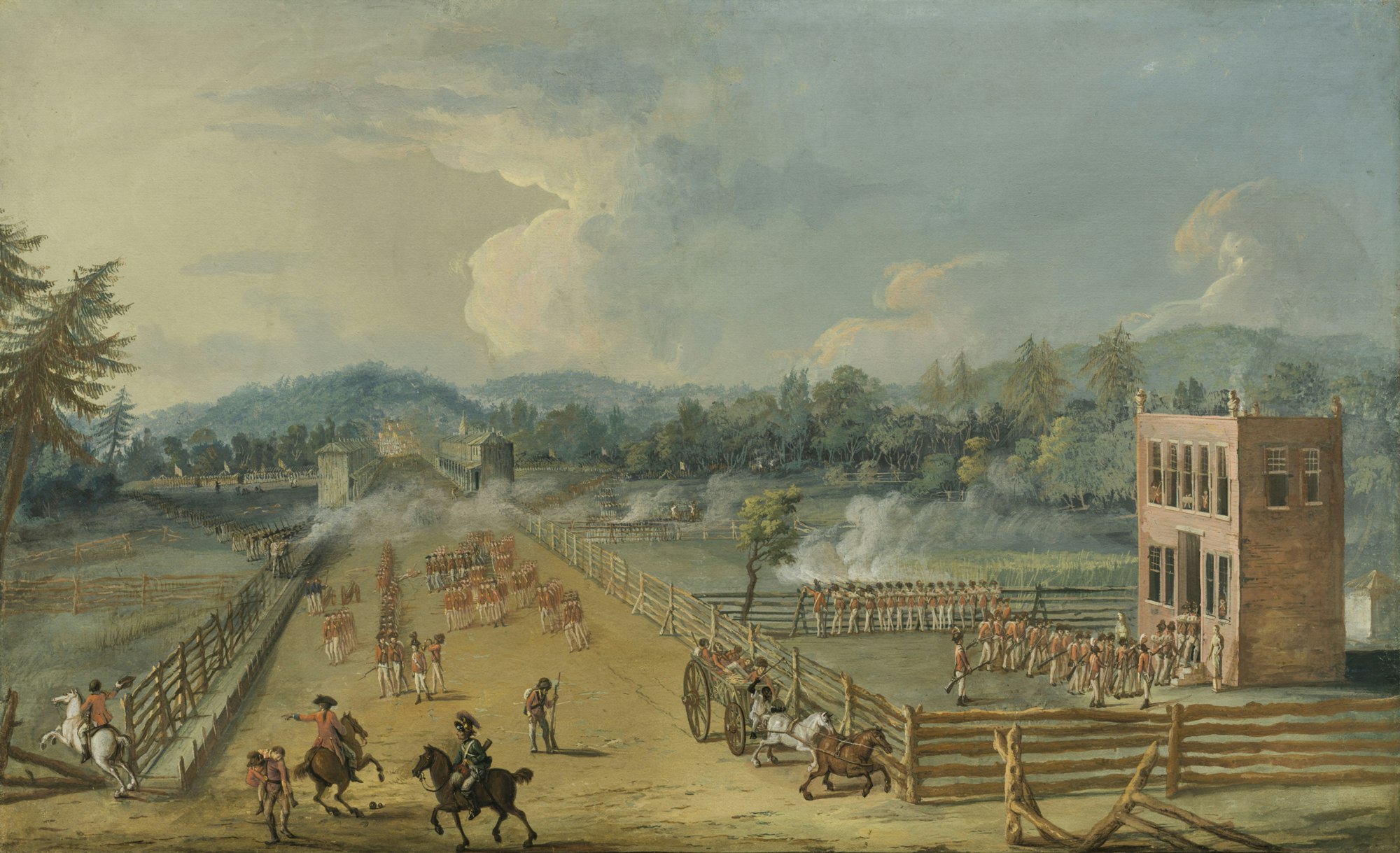
Battle of Germantown by Xavier Della Gatta (1782)
Multiple American columns would approach from different directions and strike around dawn.
Initially, the attack created real British alarm.
Then operational reality intervened.
Fog.
Darkness.
Delayed columns.
Communication failures.
Confusion between units.
The fortified Chew Family House, also known as Cliveden House, at a strategic location along Germantown Avenue, was filled with about 120 British soldiers. It stood as a majorbuilding for the Continental Army to capture.
However, a bold strategy began to unravel.
The Americans eventually withdrew.
Through The Threshold Framework™, Germantown becomes a particularly useful leadership case because it distinguishes strategic imagination from organizational execution.
Clarity Under Pressure — Regain the Initiative
Washington’s strategic purpose was larger than merely winning one battle.
Philadelphia had fallen.
The British had momentum.
Washington needed to demonstrate that the Continental Army remained capable of offensive action.
He wanted to regain the initiative.
That is Clarity Under Pressure.
After a major institutional failure, leaders can become obsessed with repairing the past.
Sometimes the better question is:
What must happen next?
Not everything lost can be restored immediately.
But momentum can sometimes be restored.
Morale as Strategy — What Do You Trust People to Do?
There is another fascinating aspect of Germantown.
Washington asked an army that had suffered repeated setbacks to execute a complicated offensive operation.
That decision communicated confidence.
Morale is influenced not simply by what leaders say about people.
It is influenced by what leaders trust them to do.
But that principle has limits.
Confidence must be matched by capability.
And Germantown exposes that tension.
Geography Matters — Complexity Is Terrain
The third pillar is Geography Matters.
At Germantown, terrain meant far more than roads and buildings.
It included fog.
Distances.
Timing.
Communication.
Command structure.
Training.
The complexity of coordinating multiple columns.
That leads to an important organizational lesson:
The organization itself is terrain.
A strategy may be excellent in theory and still exceed the institution’s ability to execute it.
Corporate leaders should ask:
Do our departments communicate well enough to execute this?
Do people understand their roles?
Can information travel quickly enough?
Do we possess the operational discipline the strategy requires?
The best strategy in the world cannot succeed if the organizational terrain cannot carry it.
Delay Is a Decision — Beware the Strategic Distraction
The fortified Cliveden House became one of the defining problems of the battle.
American forces spent time and energy attempting to neutralize British troops inside.
Continental Army troops stormed it yelling, “Remember Paoli!”
The effort became a distraction from the wider battle that swirled around them up and down Germantown Avenue.
That gives us a subtle application of Delay Is a Decision.
Organizations do not always delay by doing nothing.
Sometimes they delay by doing too much of the wrong thing.
An internal dispute.
A legacy program.
A secondary legal issue.
A procedural argument.
The organization appears very busy.
But its most important objective is waiting.
Leaders must periodically ask:
Is this still central to the mission—or has it become the thing distracting us from the mission?
Symbolic Leadership — Failure Does Not Own the Narrative
Washington lost at Germantown.
But something else happened.
American soldiers had attacked British regulars.
They had initially driven them backward.
They had demonstrated offensive capability.
Washington emphasized that point afterward.
This is Symbolic Leadership.
Leaders influence how organizations understand failure.
That does not mean spinning defeat into victory.
Germantown revealed genuine deficiencies.
But failure can expose weakness and reveal capability at the same time.
Mature leadership can hold both truths.
Germantown therefore leaves modern leaders with a question I think belongs in every boardroom:
Can our organization actually execute the strategy we have designed?
Vision matters.
Boldness matters.
Strategy matters.
But between strategy and success lies the organization itself.
And sometimes that is where the battle is really won or lost.
Until next time,
Sheilah


Leave a Reply