How the 2026 Midterm Elections Illustrate the Five Pillars of The Threshold Framework™—and Why the Hardest Leadership Decisions May Still Lie Ahead
An Election That Began With a Threshold
On November 3, 2026, Americans went to the polls and delivered an electoral transformation that extended far beyond the usual midterm shifts in political power.
Democrats captured control of both houses of Congress. They won Senate races in states that had long been considered Republican territory. They gained governorships, legislative chambers, and congressional seats across the country. Candidates who might once have been dismissed as improbable contenders became governors, senators, and representatives.
The election has been described as a blue wave. Some have called it a blue tsunami.
But I see something else.
I see a national threshold—and an opportunity to examine how leaders respond when they believe the status quo can no longer continue.
The candidates who entered these races confronted a series of decisions familiar to leaders in every profession. They had to determine what mattered most, understand the fears and aspirations of the people they hoped to represent, assess unfamiliar political terrain, decide whether to act despite formidable obstacles, and demonstrate through their conduct the kind of leadership they intended to provide.
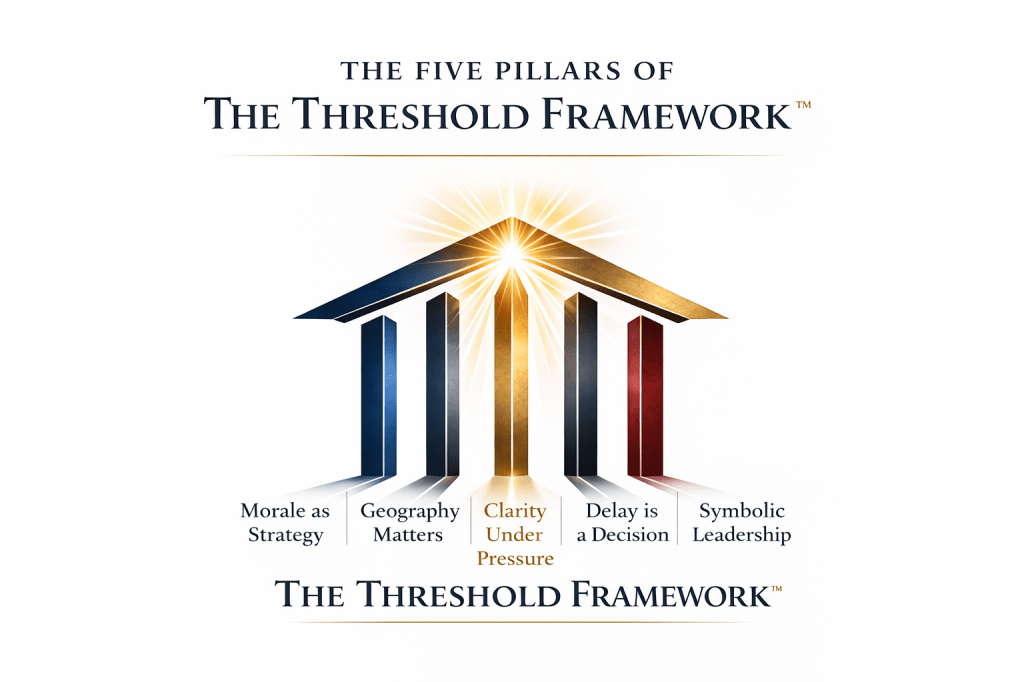
These decisions correspond closely to the five pillars of The Threshold Framework™, a leadership model I developed from my book and research into General George Washington’s decisions during the six-day Gulph Mills Encampment in December 1777, immediately preceding Valley Forge, which formed the basis of my book, Threshold to Valley Forge: The Six Days of the Gulph Mills Encampment. [See The Threshold Framework and additional articles about the application of The Threshold Framework at my blog, www.sheilahvance.com.]
The framework offers five principles:
- Clarity Under Pressure: Define what must not fail.
- Morale Is Strategy: Emotional leadership is operational leadership.
- Geography Matters: Know the terrain.
- Delay Is a Decision: Inaction communicates and carries risk.
- Symbolic Leadership: Visible conduct shapes credibility and endurance.
The framework does not belong to any political party. Its principles can be used to examine the leadership of Democrats, Republicans, independents, and individuals outside politics altogether.
But the 2026 midterm elections provide a particularly instructive case study of how these principles can operate together.
The most important question is not simply how the Democratic candidates won.
It is how the leadership decisions that helped bring them to office can inform the decisions they must now make while governing.
Pillar One: Clarity Under Pressure—Define What Must Not Fail
Every consequential leadership journey begins with a question: What is so important that it must be protected, even when the circumstances are uncertain and the obstacles appear overwhelming?
For Washington in December 1777, the answer was the survival of the Continental Army. Philadelphia had fallen to the British. The army was exhausted, inadequately supplied, and approaching winter. Washington could not guarantee victory in the next battle. But he understood that the Revolution could not survive without an army capable of continuing the struggle.
He had identified his non-negotiable.
The 2026 Democratic candidates faced a different kind of threshold.
For many, the central concerns included the rising cost of living, the affordability of health care, the price of food and housing, immigration enforcement, governmental accountability, and the appropriate limits of presidential authority.
Their challenge was to turn those concerns into a clear explanation of why they were seeking office.
That distinction matters.
A candidate can oppose an administration without articulating what must be preserved or improved. Opposition may motivate participation, but leadership requires an affirmative purpose.
The campaigns of newly elected senators such as Scott Colom of Mississippi, James Talarico of Texas, Annie Andrews of South Carolina, Sherrod Brown of Ohio, and Roy Cooper of North Carolina offer opportunities to examine how candidates presented their priorities to voters with different political histories and economic concerns.
Their circumstances were not identical. Neither were their constituencies. Yet each faced the task of explaining why a change in representation mattered.
Clarity under pressure does not require every voter to agree with a candidate’s conclusions. It requires the candidate to identify priorities, explain them coherently, and remain accountable to them.
The governing challenge: The new officeholders must now define their non-negotiables with even greater precision.
What specific improvements in affordability will they pursue? What protections for health care access will they prioritize? How will they exercise oversight while respecting constitutional limits? How will they distinguish achievable commitments from aspirations requiring longer-term cooperation?
The answers must be more specific than campaign slogans.
At the threshold of governing, clarity becomes the foundation of accountability.
Pillar Two: Morale Is Strategy—Emotional Leadership Is Operational Leadership
One of the most important lessons of Washington’s leadership during the Philadelphia Campaign is that morale was not a secondary concern.
An army that had suffered defeats, endured hunger, and faced an uncertain winter needed more than orders. Its soldiers needed a reason to continue.
Washington’s responsibility was not simply to move troops. It was to preserve their willingness to remain an army.
Modern political campaigns face a comparable leadership challenge, although the circumstances are vastly different.
Candidates must persuade volunteers to knock on doors, donors to contribute, organizers to work long hours, and citizens to believe that their participation matters.
That work requires more than an effective advertising campaign.
It requires a sense of collective purpose.
The 2026 elections took place amid widespread public frustration with economic conditions and national leadership. The Associated Press reported that concerns about high costs and demands for greater checks on presidential power contributed to the Democratic victories.
Successful mobilization in such an environment requires a difficult balance: acknowledging dissatisfaction without allowing despair to become the campaign’s defining emotion.
This is where morale becomes strategy.
A campaign that merely tells people what is wrong may reinforce their frustrations. A campaign that also offers a credible path toward improvement gives them a reason to participate.
The distinction is especially important when candidates are competing in communities where their party has struggled for years.
The governing challenge: Election-night enthusiasm will not sustain a legislative agenda indefinitely.
Newly elected officials must find ways to maintain public engagement while confronting budget limitations, institutional resistance, and the compromises inherent in democratic government.
They must also recognize that morale is not synonymous with popularity.
Sometimes preserving public confidence requires delivering disappointing news, explaining unavoidable tradeoffs, or acknowledging that a proposed solution will take longer than expected.
The leadership principle remains the same: people are more likely to sustain difficult collective work when they understand its purpose and believe their leaders are acting with integrity.
Pillar Three: Geography Matters—Know the Terrain
Perhaps the most striking feature of the 2026 elections was the breadth of the Democratic gains.
Democrats won important races in Mississippi, Texas, Kansas, Iowa, Ohio, North Carolina, and South Carolina. They also made substantial gains in state legislatures and governorships.
These results challenge simplistic assumptions about where political competition can occur.
In my Threshold Framework, geography means much more than physical location.
It includes the institutional, cultural, economic, political, and social terrain in which a leader must operate.
Washington understood the significance of geography during the Philadelphia Campaign. Roads, rivers, hills, supply routes, and the location of enemy forces shaped his available choices.
A contemporary political candidate must understand a different landscape.
What concerns dominate a particular community? How do local economic conditions shape voters’ priorities? Which institutions command trust? How do rural, suburban, and urban communities experience national policies differently?
The 2026 results illustrate why leaders cannot rely exclusively on inherited assumptions about their environment.
Consider Texas, where James Talarico won a U.S. Senate seat and Gina Hinojosa won the governorship. These victories occurred in a state where Republicans had long dominated statewide elections.
Or Kansas, where Adam Hamilton won a Senate seat despite the state’s longstanding Republican voting history.
And, to almost everyone’s surprise, Mississippi, where Scott Colom defied the odds and became the first African American elected to the U. S. Senate by one of the most conservative red states.
The results do not prove that traditional political divisions have disappeared. They demonstrate that political terrain can change and that candidates must understand the conditions of the moment rather than rely entirely on yesterday’s map.
Reuters reported that Democrats deliberately expanded their competition into traditionally Republican areas, invested in state organizations, and recruited candidates with local connections.
That approach illustrates a central lesson of the framework:
Leadership requires knowing the terrain as it actually exists—not merely as tradition suggests it should exist.
The governing challenge: The political geography of a winning coalition is not necessarily the same as the geography of a governing majority.
An elected official must now serve constituents who supported the campaign, those who opposed it, and those who did not vote.
New leaders must understand the institutions they are entering, the legal boundaries of their authority, the needs of different communities, and the interests of colleagues whose cooperation they will require.
They must also recognize that national political messages do not automatically translate into effective local policy.
Knowing the terrain remains essential after the ballots have been counted.
Pillar Four: Delay Is a Decision—Inaction Communicates and Carries Risk
There is a moment in almost every leadership crisis when someone must decide whether to act.
The information is incomplete. The outcome is uncertain. The risks are substantial.
Waiting may seem safer.
But waiting is itself a decision.
Washington confronted this reality repeatedly during the Philadelphia Campaign. He could not remain indefinitely in one position while the British controlled Philadelphia and his army’s condition deteriorated.
He had to make decisions with imperfect information.
Political candidates face a different but recognizable version of that dilemma.
For those who entered the 2026 elections against established incumbents or in traditionally Republican states, the decision to run involved uncertainty.
There was no guarantee that the political environment would produce the results ultimately recorded in November.
The choice to enter a difficult race therefore offers a useful illustration of the framework’s fourth pillar.
It is important not to romanticize that decision. Running for office is not automatically an act of exceptional leadership. Candidates have different motivations, qualifications, resources, and opportunities.
But the decision to challenge an established political pattern can be examined as a consequential choice made under uncertainty.
The 2026 results also raise an important question for those who previously believed that particular states or districts were beyond meaningful competition.
What opportunities might institutions overlook when they confuse historical patterns with permanent limitations?
The governing challenge: Delay can become even more consequential once a candidate assumes public office.
Legislators may postpone difficult decisions because of political disagreement. Governors may defer administrative reforms because of resistance from entrenched interests. Congressional leaders may avoid oversight questions because the consequences are uncertain.
Yet inaction has consequences for people waiting for decisions about health care, housing, public safety, immigration, and economic opportunity.
This does not mean that every problem requires immediate action.
Deliberation, consultation, and procedural fairness are essential elements of responsible government.
The distinction is between thoughtful preparation and avoidance.
A leader must be able to explain not only what action is being taken, but also why a decision is being delayed.
Pillar Five: Symbolic Leadership—Visible Conduct Shapes Credibility and Endurance
Leadership is communicated through conduct as well as words.
People observe where leaders go, whom they meet, how they respond to criticism, what they prioritize, and whether their behavior reflects their stated commitments.
During the winter of 1777, Washington’s physical presence with his army carried significance beyond the military orders he issued.
His conduct communicated that he shared responsibility for the army’s future.
The 2026 elections produced several historic milestones that illustrate the symbolic dimension of public leadership.
Keisha Lance Bottoms became the first Black woman elected governor in the United States. Other elections produced milestones involving Native American, Muslim, and openly gay representation in the Senate and in state government.
These developments have symbolic significance because they expand the range of experiences and backgrounds visibly represented in American political institutions.
But symbolic leadership is not limited to historic firsts.
A candidate who visits a community that has rarely received attention is making a statement about whose concerns matter.
An elected official who listens respectfully to political opponents communicates something about the responsibilities of public service.
A governor who explains a difficult budget decision directly to affected residents demonstrates a form of accountability that cannot be replaced by a press release.
The governing challenge: Symbols must be supported by substance.
Historic representation can create expectations and opportunities. It does not, by itself, guarantee effective policy or responsible administration.
Likewise, public appearances cannot substitute for measurable results.
The test of symbolic leadership is whether visible conduct reinforces the commitments a leader has made.
When words and actions diverge, credibility suffers.
When they remain aligned, trust has an opportunity to grow.
The Second Threshold: From Campaigning to Governing
The first threshold was the decision to run.
The second was the campaign itself.
The third was Election Day.
Now comes another threshold, perhaps the most consequential of all.
The transition from campaigning to governing.
The skills that help a candidate win an election do not automatically ensure effective governance.
Campaigns emphasize differences. Governing often requires negotiation.
Campaigns can promise change. Governing requires decisions about resources, legal authority, implementation, and competing priorities.
Campaigns operate toward a defined election date. Governing requires sustained attention to problems that may take years to resolve.
The newly elected Democratic majorities will enter Congress with significant authority to shape legislation, conduct oversight, and evaluate presidential appointments.
But they will also confront constitutional limits, differences within their own party, opposition from Republicans, and the continuing authority of the executive branch.
Some voters may view the results primarily as a rejection of President Trump. Others may see them as a demand for economic relief or a broader change in political priorities.
Those interpretations are not necessarily identical.
The new leaders would be wise to distinguish between them rather than assume that an electoral victory represents unanimous agreement on every policy proposal.
The Threshold Framework provides a disciplined way to approach this challenge.
Five questions for the first 100 days
Clarity Under Pressure: What three outcomes will define the administration’s or legislative majority’s initial work, and how will the public know whether progress has occurred?
Morale Is Strategy: How will leaders sustain the confidence of their supporters while also engaging citizens who voted against them?
Geography Matters: What must leaders learn about the institutional, economic, and political terrain before attempting major reforms?
Delay Is a Decision: Which decisions require prompt action, which require additional consultation, and how will leaders explain the difference?
Symbolic Leadership: What visible actions will demonstrate accountability, ethical conduct, transparency, and respect for the responsibilities of public office?
These questions apply equally to leaders of either party.
They are not partisan tests. They are leadership disciplines.
A Lesson From Gulph Mills
In December 1777, Washington faced a situation that could not be resolved through a single victory.
The British occupied Philadelphia. His army had suffered significant setbacks. Supplies were inadequate, and winter was approaching.
At Gulph Mills, Washington’s leadership challenge was not to declare that the Revolution had been saved.
It was to make the decisions necessary to keep the army capable of continuing.
That distinction is central to understanding leadership at a threshold.
A breakthrough is not the same as a completed mission.
A turning point creates new possibilities. It does not eliminate the work required to realize them.
The Democratic victories of November 2026 have changed the balance of political power in the United States.
They have also created new responsibilities.
The candidates who sought office because they believed the country faced serious problems must now demonstrate how their proposed solutions can operate within the institutions of government.
Their success will require the same disciplines that The Threshold Framework identifies: clarity, morale, an understanding of terrain, timely decisions, and conduct that earns credibility.
These principles do not guarantee success. They provide a way to evaluate leadership decisions, identify risks, and maintain focus when circumstances become difficult.
The Real Meaning of a Threshold
There is a temptation after a major election to treat victory as the conclusion of the story.
But thresholds are not destinations.
They are passages from one set of circumstances into another.
Washington’s army did not emerge from Gulph Mills into comfort or certainty. It marched into Valley Forge, where new hardships and difficult decisions awaited.
Yet the decisions made before that march helped preserve the possibility of continuing the Revolution.
That is the enduring lesson I see in the 2026 elections.
The significance of the Democratic victories extends beyond the number of seats won or the historical records broken.
They provide an opportunity to study how leaders recognize changing circumstances, decide to act, mobilize others, and assume responsibility for what follows.
The ultimate test will not be the size of the electoral wave.
It will be the quality of the leadership exercised after it.
Winning may bring leaders to the threshold. What they do next determines how they cross it.
Sheilah Vance, Esq., is the creator of The Threshold Framework™, a leadership model drawn from her research into General George Washington’s decisions during the 1777 Philadelphia Campaign. She is the author of Threshold to Valley Forge: The Six Days of the Gulph Mills Encampment and writes about leadership, history, institutional change, and decision-making under pressure.


Leave a Reply