
When a Law Firm Reaches the Threshold: Leadership Lessons from the Crisis at Weil Gotshal
What the unfolding dissolution of a major American law firm teaches us about leadership, institutional survival, and the decisions that cannot wait.
By Sheilah Vance, Esq.
Creator, The Threshold Framework™ and author, Threshold to Valley Forge: The Six Days of the Gulph Mills Encampment
A law firm can survive the loss of a major client. It can survive the departure of an important partner. It can even survive a difficult leadership transition.
But what happens when all three challenges converge, when confidence in the institution begins to erode, and when the people who built the firm’s success begin making decisions about their futures elsewhere?
That is the leadership question emerging from the extraordinary developments at Weil, Gotshal & Manges, one of America’s most prominent law firms.
In late October 2026, after months of significant partner departures and unsuccessful merger discussions, Weil’s management committee recommended an orderly wind-down of the firm. In early November, the legal profession watched as major competitors positioned themselves to recruit Weil’s lawyers and acquire important practice capabilities.
For an institution founded in 1931, the prospect of dissolution represents far more than the closing of a business. It raises fundamental questions about institutional identity, succession, governance, professional responsibility, and the obligations of leadership.
For me, the unfolding situation illustrates something I have been exploring through The Threshold Framework™: Organizations are often defined not by the crises they encounter, but by the decisions their leaders make when familiar strategies no longer work.
And every law firm, regardless of its size, should be paying attention.
The Crisis Beneath the Headlines
The reporting is striking.
Weil, a firm with approximately 1,200 lawyers, had long enjoyed a distinguished reputation in corporate transactions, private equity, restructuring, and complex litigation.
Yet its institutional future became uncertain following departures of influential partners and failed efforts to find a merger partner.
On November 4, Reuters reported that Gibson Dunn was in discussions to recruit approximately 120 Weil lawyers in the United States and London, including more than 20 partners.
Two days later, Kirkland & Ellis confirmed that Ramona Nee, who had been selected to succeed Weil’s longtime executive partner Barry Wolf, would join Kirkland with a team of approximately 40 lawyers.
Other partners were moving to firms including Goodwin Procter and Quinn Emanuel.
These developments do not establish that a particular management decision caused Weil’s difficulties. Nor do they provide a complete picture of the firm’s internal deliberations.
They do, however, reveal a profound institutional challenge.
When key partners depart, the consequences extend beyond lost revenue. Client relationships may move. Practice groups may become less viable. Remaining partners may question their own futures. Associates and staff may wonder whether their careers are secure.
Eventually, the institution may face a question that no amount of reputation or history can answer:
What must we preserve, and what are we prepared to change, to survive?
That is a threshold question.
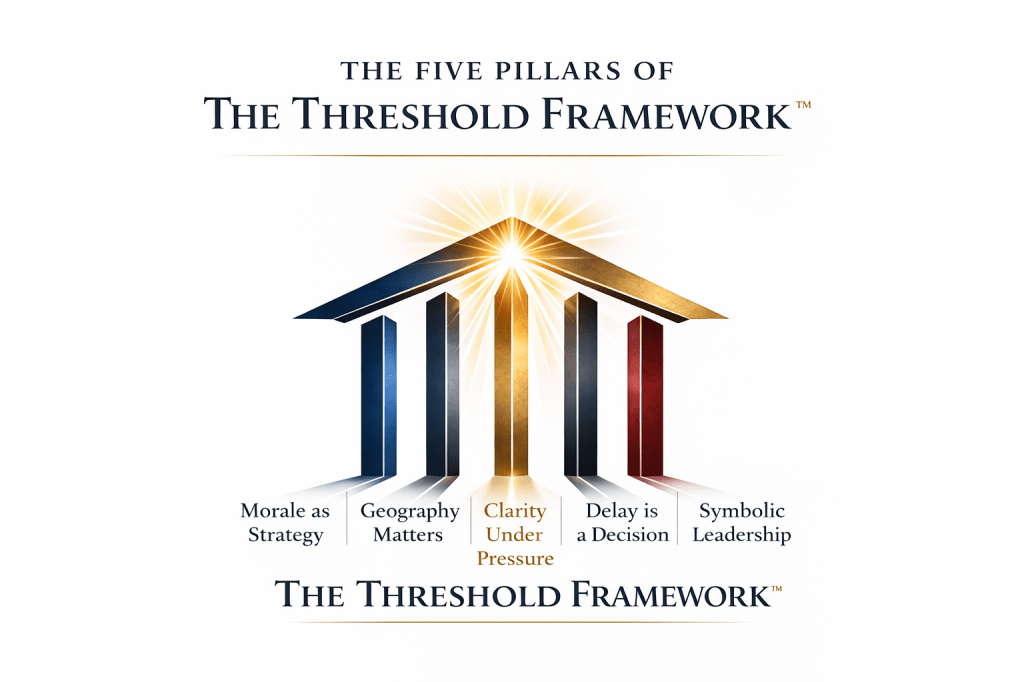
The Threshold Framework™
I developed The Threshold Framework™ through my research into General George Washington’s leadership during the December 1777 Gulph Mills Encampment, immediately preceding the Continental Army’s arrival at Valley Forge. This research formed the basis of my book, Threshold to Valley Forge: The Six Days of the Gulph Mills Encampment.
Washington had experienced a series of military setbacks during the Philadelphia Campaign. His army was exhausted, poorly supplied, and facing an uncertain future.
He could not reverse every defeat. He could not immediately provide every resource his soldiers needed.
But he could make decisions that preserved the army’s ability to continue the struggle.
From that historical experience, I developed five leadership principles that apply to contemporary institutions confronting uncertainty and consequential change.
The developments at Weil provide a timely opportunity to examine those principles.
1. Clarity Under Pressure: Define What Must Not Fail
When an institution enters a crisis, leaders often become consumed by immediate problems.
Who is leaving? Which clients are at risk? Can a merger be negotiated? How will the remaining partners respond?
These questions matter. But they can obscure the more fundamental question: What is the institution trying to preserve?
At Gulph Mills, Washington faced an army that had lost battles and territory. His central responsibility was not to preserve every position. It was to preserve the Continental Army as a functioning force.
That distinction mattered.
For a law firm experiencing institutional instability, clarity requires identifying its non-negotiables.
Those may include continuity of client representation, financial responsibility, professional obligations, the retention of essential practice capabilities, and the protection of employees.
A firm may ultimately conclude that remaining independent is no longer feasible. But that decision should follow a disciplined assessment of what can be preserved and what cannot.
Leadership lesson: A law firm’s identity cannot rest solely on its name, prestige, or historical achievements. Leaders must define the institution’s essential purpose and the capabilities required to fulfill it.
2. Morale Is Strategy: Confidence Is an Institutional Asset
Law firms are unusual organizations.
Their most valuable assets can leave the building.
Partners control important client relationships. Associates possess institutional knowledge and professional expertise. Staff members sustain the operational infrastructure.
Unlike a manufacturing enterprise, a law firm’s productive capacity is not primarily embedded in equipment or facilities. Much of it resides in people and their willingness to remain committed to a shared institution.
That makes morale a strategic concern.
As Weil’s situation unfolded, reports described uncertainty among hundreds of associates facing the prospect of finding new employment.
The consequences of that uncertainty extend beyond individual career decisions.
When people lose confidence in an institution’s future, they begin acting to protect themselves. Their decisions may be entirely reasonable, but collectively they can accelerate organizational instability.
At Gulph Mills, Washington understood that an army could be defeated by exhaustion, fear, and discouragement as surely as by enemy fire.
He had to maintain the confidence of soldiers whose immediate circumstances offered few reasons for optimism.
The same principle applies to law firm leadership.
Communication, transparency, and visible concern for colleagues are not merely exercises in employee relations. They are essential to institutional resilience.
Leadership lesson: A management committee that treats morale as secondary to financial strategy may discover that its financial strategy depends on the confidence it has neglected.
3. Geography Matters: Know the Terrain Before Making the Decision
Geography is more than physical location.
In The Threshold Framework™, geography includes the institutional, competitive, political, and operational environment in which leaders must act.
For Washington, terrain shaped military possibilities.
For law firm leaders, the terrain includes client relationships, partner compensation, practice-group economics, market competition, governance structures, and the firm’s position relative to competitors.
The competitive environment confronting major American law firms has changed dramatically.
Large firms compete aggressively for high-revenue partners and practice groups. Compensation arrangements can create powerful incentives for lateral movement.
Meanwhile, clients increasingly evaluate firms according to specialized capabilities, geographic reach, and the ability to assemble sophisticated teams.
The reported discussions involving Gibson Dunn and approximately 120 Weil lawyers illustrate how one firm’s institutional crisis may create a strategic opportunity for another.
But opportunities carry risks.
A receiving firm must consider whether incoming partners fit its culture, whether their practices complement existing capabilities, and whether the organization can absorb substantial growth without creating new tensions.
Leadership lesson: Before making a major strategic decision, leaders must understand both the external competitive environment and the internal capacity of their institution.
4. Delay Is a Decision: The Cost of Waiting
Perhaps the most uncomfortable leadership principle is this one:
Doing nothing is rarely neutral.
Inaction communicates.
It may signal uncertainty, disagreement, or an unwillingness to confront difficult realities.
In a law firm, delayed decisions can have consequences that become progressively harder to reverse.
A succession plan may lose credibility. Merger opportunities may disappear. Partners may seek more predictable environments. Clients may begin considering alternatives.
The reporting about Weil’s unsuccessful merger discussions and continuing partner departures raises an important question for law firm leaders generally:
When does the effort to preserve existing arrangements become an obstacle to necessary change?
This is not a claim that Weil’s leaders should have made a particular decision earlier. The public record does not establish when different alternatives were realistically available.
Rather, the case illustrates why every management committee needs clear decision points.
At Gulph Mills, Washington could not remain indefinitely in an unsustainable position. Winter was approaching, supplies were inadequate, and the army needed a defensible location.
Eventually, remaining in place would itself become a strategic choice.
Leadership lesson: Leaders should establish measurable triggers for action before a crisis narrows their available options.
5. Symbolic Leadership: What Leaders Do Becomes the Message
Leadership is communicated through more than formal announcements.
It is communicated through conduct.
When a firm experiences instability, its partners, associates, staff, and clients watch what leaders actually do.
Do senior partners remain engaged in client transitions? Are associates treated with respect? Are employees given meaningful information? Does management accept responsibility for difficult decisions?
These actions shape how an institution is remembered.
Reports indicate that Weil’s wind-down planning included arrangements concerning compensation and partner departures. The adequacy and ultimate implementation of those arrangements cannot yet be fully assessed.
But the broader leadership principle is clear.
Even when an institution cannot preserve its existing structure, its leaders retain responsibility for how the transition unfolds.
Washington’s conduct at Gulph Mills demonstrated that leadership was not merely a matter of issuing orders. His visible decisions helped establish the conditions under which an exhausted army could continue.
For law firms, symbolic leadership is equally consequential.
Leadership lesson: When institutional survival is uncertain, leaders should demonstrate their professional values through visible decisions, particularly those affecting people with the least power to protect themselves.
The Questions Every Managing Partner Should Be Asking
The developments at Weil should not be dismissed as a problem unique to one large Wall Street firm.
Smaller firms face their own thresholds.
A founding partner retires without a succession plan.
A major institutional client changes counsel.
A profitable practice group leaves.
Two partners disagree about the firm’s future.
A merger proposal forces the partnership to confront questions about identity and independence.
The scale differs, but the underlying leadership challenges are familiar.
Every law firm management committee should be asking:
- What are the three things our firm cannot afford to lose?
- How much of our institutional stability depends on a small number of partners or clients?
- Do our associates and staff understand our long-term direction?
- What conditions would trigger a serious discussion about restructuring, merger, or succession?
- Are our leaders demonstrating the values we expect the institution to uphold?
These are not questions to ask only after a crisis begins.
They are questions that responsible leaders should be asking now.
The Threshold Is Not the End of the Story
The Continental Army’s experience at Gulph Mills was not a victory in the traditional military sense.
Washington had not liberated Philadelphia. His army remained exhausted and undersupplied.
Yet the decisions made during that period helped position the army to survive the winter at Valley Forge and continue the Revolution.
That is the deeper meaning of a threshold.
It is the moment when leaders must recognize that the path forward will not look like the path behind them.
For Weil, the reported wind-down represents the potential end of a distinguished institutional history. For the lawyers and staff affected, it also represents a period of professional transition and uncertainty.
For the broader legal profession, it should be a reminder that prestige, profitability, and history cannot substitute for sound governance, institutional confidence, and timely decision-making.
The most important leadership question is not whether your law firm will encounter a threshold.
It is whether your leaders will recognize it—and act—before the institution loses the capacity to choose its future.
Sheilah Vance, Esq., is an attorney, author, and creator of The Threshold Framework™, a five-pillar leadership model developed from her research into George Washington’s leadership during the 1777 Gulph Mills Encampment. She is the author of Threshold to Valley Forge: The Six Days of the Gulph Mills Encampment and develops leadership programs, CLEs, and retreats for law firms and other institutions.
This article draws upon publicly reported developments as of November 10, 2026. The leadership interpretations are the author’s analysis, not findings concerning the conduct or responsibilities of particular individuals.


Leave a Reply