by Sheilah Vance
History Remembers July 4. Leadership Changed the World on July 2.
Every American schoolchild learns that July 4, 1776 marks the birth of the United States. Fireworks explode every year on that date because it appears at the top of the Declaration of Independence.
Yet the nation was not actually born on July 4.
The defining leadership decision—the moment when thirteen separate colonies crossed the threshold from resistance to revolution—occurred two days earlier, on July 2, 1776, when the Continental Congress voted to declare the colonies “free and independent States.”
John Adams understood the significance immediately. Writing to his wife Abigail on July 3, he predicted that July 2 would become America’s great national celebration because it was “the most memorable epocha in the history of America.”
He was correct about the importance of the day, even if history later celebrated a different date.
The vote on July 2 was not merely a political act.
It was one of history’s greatest examples of leaders standing at a threshold.
In my work developing The Threshold Framework™, I have studied leadership moments when uncertainty, risk, incomplete information, and irreversible consequences converge. These moments require leaders to decide whether to advance, retreat, or remain frozen.
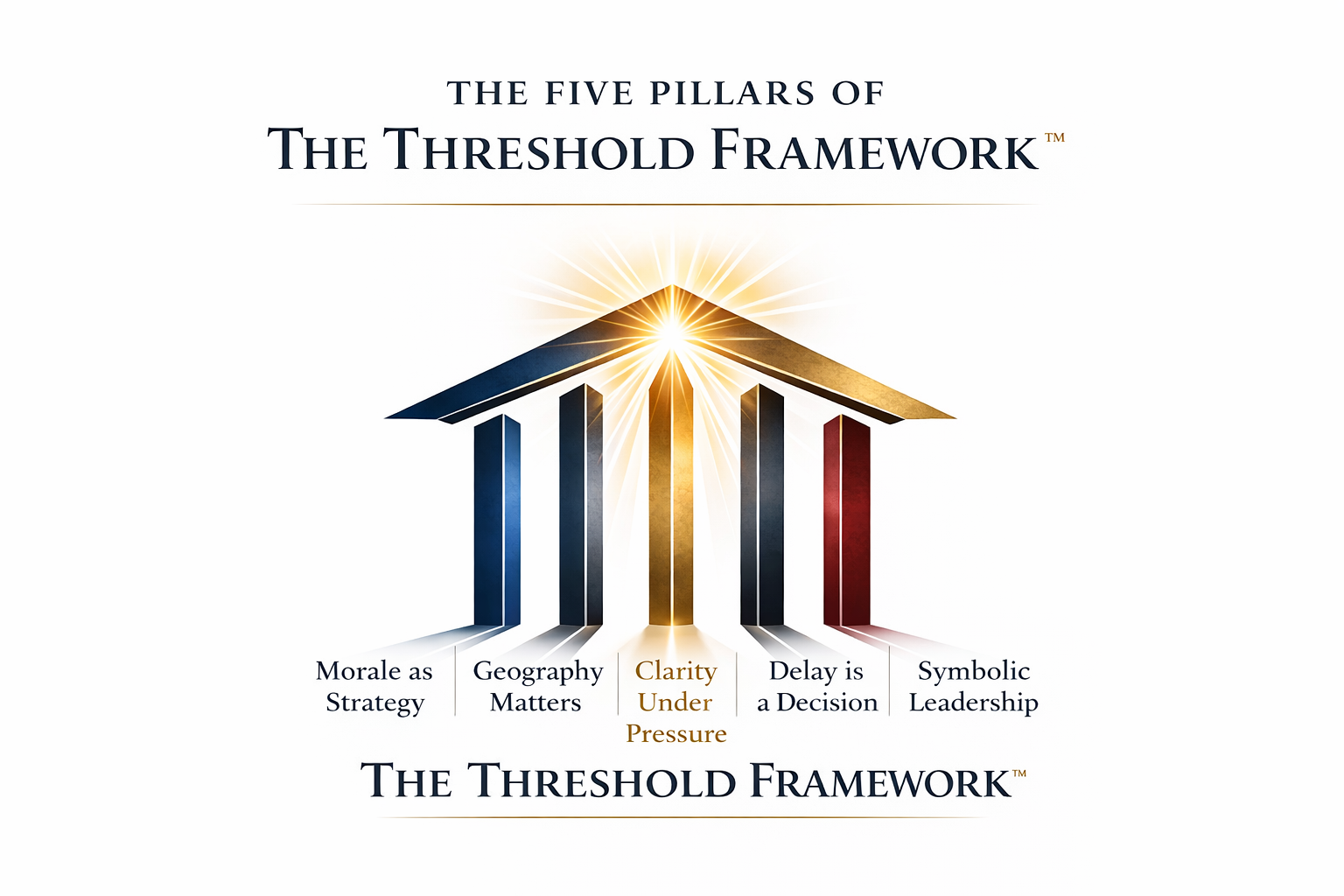
Developed through my research into General George Washington’s leadership during the six-day encampment at Gulph Mills in December 1777 for my book, Threshold to Valley Forge: The Six Days of the Gulph Mills Encampment. The Threshold Framework identifies five principles that emerge whenever leaders must make consequential decisions under conditions of uncertainty, incomplete information, competing priorities, and significant personal risk. This Framework is a critical thought and action model that is grounded in original historical documents from those six days, which was a pivotal microcosm of the Revolutionary War and the American Revolution.
Few examples illustrate this better than July 2, 1776.
The delegates knew exactly what crossing this threshold meant.
Failure would mean execution for treason.
Success would create a new nation.
The vote demonstrates each of the five principles of The Threshold Framework.
Pillar I
Clarity Under Pressure
Define What Must Not Fail.
The weeks before July 2 were filled with disagreement.
Many delegates still hoped reconciliation with Britain remained possible.
Others believed independence had become inevitable after Lexington, Concord, Bunker Hill, the Siege of Boston, and the King’s rejection of the Olive Branch Petition.
The question was no longer whether grievances existed.
The real question became:
What must not fail?
Washington had already committed the Continental Army to the field.
Thousands had already died.
The colonies had effectively entered a war that could no longer be ended by compromise alone.
Congress recognized that ambiguity itself had become dangerous.
An army cannot fight indefinitely for an undefined political objective.
Foreign governments cannot support a people who refuse to define themselves.
Citizens cannot sustain sacrifice without understanding its purpose.
The Continental Congress therefore established extraordinary clarity.
The objective was no longer improved treatment within the British Empire.
The objective became independence.
This represents the first pillar of The Threshold Framework.
Great leaders simplify complexity by identifying the one objective that cannot be allowed to fail.
Everything else becomes secondary.
The July 2 vote transformed uncertainty into strategic clarity.
Pillar II
Morale as Strategy
Emotional Leadership Is Operational Leadership.
The vote also recognized something leaders often overlook.
People do not sacrifice for policies.
They sacrifice for purpose.
By July 1776, soldiers had endured months of hardship.
Families had lost fathers and sons.
Communities had divided against one another.
Without a compelling reason to continue, morale could collapse.
The Declaration provided that reason.
Even before the document was formally engrossed and signed, Congress’s decision gave the Continental Army a new mission.
They were no longer defending colonial rights.
They were fighting for a nation.
That emotional shift changed military effectiveness.
Purpose strengthens endurance.
Shared vision creates resilience.
Hope becomes operational power.
The Threshold Framework teaches that morale is never merely emotional.
It is strategic infrastructure.
July 2 illustrates this principle perfectly.
Pillar III
Delay Is a Decision
Every threshold eventually demands a choice.
For months Congress postponed independence.
Delegates negotiated.
Petitioned.
Debated.
Waited.
Each delay reflected uncertainty.
But delay itself carries consequences.
The longer Congress postponed independence, the more difficult military operations became.
Foreign governments hesitated.
Supply chains weakened.
Public confidence fluctuated.
Eventually Congress recognized a timeless leadership truth:
Choosing not to decide is itself a decision.
July 2 represents the moment when Congress stopped allowing events to dictate history and instead began shaping history through deliberate action.
The vote reminds modern leaders that uncertainty rarely disappears before major decisions.
Waiting forever is impossible.
Leadership requires choosing despite incomplete information.
Pillar IV
Geography Matters
The Declaration is often viewed only as political philosophy.
Yet geography profoundly influenced the decision.
The colonies stretched more than a thousand miles along the Atlantic coast.
Communication required weeks.
Military threats emerged from Canada, New York, the Chesapeake, Charleston, and the western frontier.
Each colony possessed unique political realities.
The delegates understood that independence could survive only if geographically diverse colonies chose to become one political people.
This was not simply an ideological union.
It was a geographic one.
They deliberately linked New Hampshire with Georgia.
Massachusetts with South Carolina.
Pennsylvania with Rhode Island.
Virginia with Delaware.
The vote created unity across distance.
The Threshold Framework reminds leaders that every important decision occurs within a geographic environment.
Markets.
Communities.
Campuses.
Corporations.
Battlefields.
Geography shapes options.
The Continental Congress succeeded because it recognized geography rather than ignoring it.
Pillar V
Symbolic Leadership
The Declaration became one of history’s greatest acts of symbolic leadership.
The July 2 vote changed legal reality.
The Declaration changed public imagination.
Its words transformed political action into moral purpose.
The delegates understood symbolism.
They publicly pledged:
“Our Lives, our Fortunes, and our sacred Honor.”
This sentence mattered because symbols create commitment.
Leadership is not simply about making decisions.
It is about helping people understand why those decisions matter.
The signatures became symbols.
The parchment became a symbol.
The ringing of bells became a symbol.
The reading of the Declaration in town squares became a symbol.
The Continental Army carried those symbols into battle.
The new nation carried them into history.
The Threshold Framework teaches that symbolic leadership multiplies the impact of every decision.
July 2 illustrates that principle better than perhaps any event in American history.
The Threshold Moment
Leadership scholars often search for dramatic moments.
Crossing the Delaware.
Gettysburg.
D-Day.
The moon landing.
Yet many of history’s greatest threshold moments occur quietly.
Behind closed doors.
Around conference tables.
Inside boardrooms.
Inside legislative chambers.
On July 2, 1776, fifty-six men were not yet signing an immortal document.
They were making a decision.
One vote.
One threshold.
One irreversible commitment.
Everything that followed—including the Declaration itself—flowed from that decision.
Leadership Lessons for Today
Modern executives, university presidents, nonprofit leaders, military officers, elected officials, attorneys, and entrepreneurs rarely face the possibility of execution for treason.
But they regularly face threshold decisions.
Should we merge?
Should we disclose?
Should we litigate?
Should we restructure?
Should we close?
Should we launch?
Should we speak?
Should we act now—or wait?
The Threshold Framework offers the same questions the Continental Congress answered on July 2:
- What must not fail?
- How will this decision affect morale?
- Are we delaying because delay truly helps—or because we fear deciding?
- How does our environment shape this decision?
- What message will our decision send beyond its immediate outcome?
These questions transform leadership from reaction into intention.
Conclusion
History celebrates July 4 because it gave America its enduring words.
But July 2 gave America its defining decision.
The Declaration of Independence was not merely written.
It was preceded by a threshold.
Before there could be inspiring language, there had to be courageous leadership.
Before there could be signatures, there had to be votes.
Before there could be independence, there had to be a decision that could never be undone.
That is why July 2 deserves renewed attention.
It reminds us that nations, like organizations, are ultimately transformed not by documents alone, but by leaders willing to cross the threshold when history demands it.
The Continental Congress crossed that threshold on July 2, 1776.
Their example continues to illuminate the path for leaders nearly two and a half centuries later.
About the Author
Sheilah Vance is the creator of The Threshold Framework™, a leadership model that examines how individuals and organizations make consequential decisions under conditions of uncertainty, pressure, and irreversible change. She is the author of Threshold to Valley Forge: The Six Days of the Gulph Mills Encampment and applies Revolutionary War leadership lessons to modern governance, law, higher education, business, and executive decision-making.


Leave a Reply