Introduction
Military history often remembers generals.
But battles are carried by soldiers.
On December 11, 1777, at the Battle of Matson’s Ford along the Schuylkill River, about 15 miles from Philadelphia, the survival of the 11,000 members of the Continental Army depended not only on the leadership of General George Washington and his commanders, but also on the ordinary soldiers and militia members who endured freezing conditions, confusion, exhaustion, artillery fire, and direct combat while protecting the army’s movement toward eventual encampment at Valley Forge.
Some were wounded. Some were killed. Others were taken prisoner.
Many of those who suffered and fought in the battle were part of the Pennsylvania Militia units that were under the command of a very battle-worn but outstanding leader, Brigadier General James Potter.
Many whose names history never fully preserved nevertheless stood at the threshold between survival and collapse for the American cause.
The Battle of Matson’s Ford was not among the largest engagements of the Revolutionary War. Yet for the soldiers involved, it was immediate, personal, and deadly. Their sacrifice bought time for the Continental Army to cross the Schuylkill River and avoid potentially catastrophic British interception.
Using the five pillars of The Threshold Framework™, this article focuses not on strategy alone, but on the human cost of leadership decisions and the lived experience of the soldiers who bore those decisions in their bodies.

I. CLARITY UNDER PRESSURE: Soldiers Fighting for Survival
For Washington, the strategic objective was clear:
The army had to survive.
But clarity at the command level translated into danger at the soldier level.
On December 11, 11,000 members of the Continental Army stood ready to march across the Schuylkill River at the Matson’s Ford, on a rickety bridge that they had built, and into the rural village of Gulph Mills, a place of towering hills, large plantations, and strategic advantage. Washington decided to move his army further away from the British Army, which was ensconced in Philadelphia since it captured the new United States’ largest city in September 1777.
Washington wanted his tired army to have more distance from the British because on December 5, the majority of the British Army marched out of Philadelphia to engage with the Continental Army at its encampment in Whitemarsh, where the Continental Army had spent the last six weeks. Washington thought the British were going to start one more major battle before both armies went into winter quarters to rest, regroup, and prepare to fight again in the spring. The British and American armies skirmished around the edges of their main forces in the Battle of Whitemarsh up until December 8, when British General Howe unexpectedly withdrew his forces back to Philadelphia.
By the morning of December 11, some 800 Continental Army soldiers under the command of Major General John Sullivan had already crossed over the Matson’s Ford when they were surprised by several thousand British soldiers up on the high Conshohocken Hills in Gulph Mills. Sullivan was not sure whether the entire British Army had come out again to fight the Continental Army. He ordered his 800 soldiers to retreat back over the bridge they had just built and to destroy it.
About 600 soldiers mostly from the Pennsylvania Militia, under the command of Brigadier General James Potter and Lieutenant Colonel John Lacey, who Washington sent out as advance parties on December 10 to watch the British army movements. They were stationed in three groups at three posts a few miles from each other all the way on the road from Philadelphia towards Gulph Mills. The soldiers at the post closest to Philadelphia were surprised to see another few thousand British soldiers marching towards them.
Potter, Lacey, and their soldiers, vastly outnumbered, retreated strategically under heavy British fire, moving back from one post to another, down the road towards the Matson’s Ford, to warn the Continental Army. The soldiers conducted delaying operations as best as they could despite limited supplies, uneven training, and substantial vulnerability. Eventually, the soldiers had to retreat chaotically, shooting and fighting, running and riding to save their lives and those of their fellow Continental Army soldiers—the several hundred at their side and the 11,000 down at the Matson’s Ford.
The soldiers understood the stakes even if they did not know the entire operational plan.
Every minute they resisted mattered.
Every stand delayed British advance.
Every casualty purchased time.
For those on the line, leadership clarity did not eliminate suffering—it gave suffering purpose.
Threshold Insight:
When leaders clearly define what must not fail, soldiers and citizens alike can endure extraordinary hardship in service of that mission.
II. MORALE IS STRATEGY: Human Endurance Under Extreme Strain
The men at Matson’s Ford were already physically depleted before the fighting began.
Most soldiers of the Continental Army in December 1777 lacked adequate clothing, food, shoes, and shelter. Militia units often faced even harsher conditions. The cold penetrated uniforms. Hunger weakened bodies. Disease hovered constantly.
Under such circumstances, morale was not emotional excess—it was survival infrastructure.
The soldiers who remained in formation, guarded crossings, moved artillery, ferried supplies, or held defensive positions under fire even as they retreated from much larger British forces did so because they believed their sacrifice still mattered.
Leadership shaped that belief.
Washington’s visible steadiness as he waited and consulted with his generals back on the Whitemarsh side of the river, Sullivan’s strategic retreat back across the Matson’s Ford, Potter’s and Lacey’s disciplined defensive posture and the continuing resistance of militia forces in a chaotic situation while some fell wounded or died around them, communicated that the army had not collapsed.
Threshold Insight:
Morale is not optimism.
It is the decision to continue despite suffering.
III. DELAY IS A DECISION: Soldiers Paying for Time
At Matson’s Ford, time itself became currency.
And soldiers paid for it.
Washington could not wait indefinitely to move the army. Sullivan could not hold forever. Potter and Lacey could not engage without risk.
Every delaying action exposed men to injury or death.
Potter’s soldiers’ roles as advance guards were fundamentally sacrificial: absorb pressure long enough for the larger force to survive and go on to cross without interference the next day.
History often records such movements clinically:
“The army crossed successfully.”
But beneath that sentence were human bodies:
- soldiers standing in freezing mud,
- militia exchanging fire with advancing forces,
- exhausted men attempting organized withdrawal under pressure,
- wounded soldiers left struggling through winter terrain.
The survival of the army required somebody to remain exposed longer than safety allowed.
Threshold Insight:
Delay is never abstract.
Someone always bears the cost of the time a leader needs.
IV. GEOGRAPHY MATTERS: The Battlefield as Physical Hardship
The geography of Matson’s Ford intensified suffering.
The Schuylkill River crossing was difficult in winter conditions. Roads became treacherous. Mud slowed movement. Ice and cold compounded exhaustion.
Terrain shaped not only military possibility, but physical human endurance.
For wounded soldiers, geography could determine survival:
- whether evacuation was possible,
- whether supplies could reach them,
- whether retreat remained orderly or became chaos.
Militia forces operating in wooded and uneven terrain faced added uncertainty. Visibility, communication, and mobility all became compromised.
The battlefield itself became an adversary.
Threshold Insight:
Leaders must understand that environments do not merely shape strategy—they shape human survival.
V. SYMBOLIC LEADERSHIP: The Meaning of Sacrific
The soldiers at Matson’s Ford fought not merely because they were ordered to fight.
They fought because leadership communicated meaning.
Washington’s presence conveyed resolve. Sullivan’s retreat conveyed preservation. Potter and Lacey’s resistance conveyed that the army remained functional and united.
For soldiers facing death or injury, symbolic leadership mattered profoundly.
People can endure extraordinary hardship when they believe:
- their suffering is seen,
- their sacrifice serves purpose,
- and their leaders understand the weight of what is being asked.
The soldiers at Matson’s Ford became part of a larger act of endurance that made Valley Forge—and eventually independence—possible.
Many of their names faded from popular memory.
But their sacrifice remains embedded in the survival of the nation itself.
Threshold Insight:
The deepest test of leadership is whether people believe their sacrifice matters.
Conclusion: Remembering the Human Threshold
The Battle of Matson’s Ford was not only a strategic movement.
It was a human threshold.
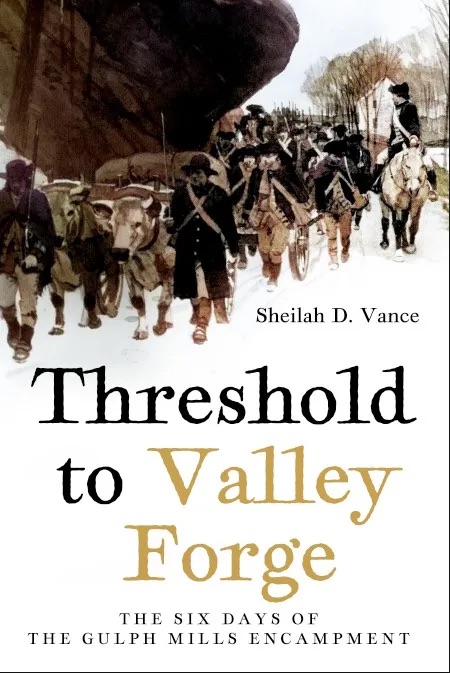
Behind every successful crossing stood soldiers carrying muskets through freezing weather, wounded men struggling to continue, militia forces delaying stronger opponents, and families who would later receive news of injury or death. I include some of those soldiers’ and families’ stories in my book, Threshold to Valley Forge: The Six Days of the Gulph Mills Encampment.
The leadership decisions of December 11, 1777 mattered because human beings bore their consequences.
And that truth remains relevant today.
Every leadership decision—in government, law, education, military service, or organizational life—ultimately affects people who must absorb the cost of those choices.
The soldiers of Matson’s Ford remind us this Memorial Day:
Leadership is never merely operational.
It is human.


Leave a Reply