Every generation encounters moments that change history forever.
Sometimes those moments arrive quietly. Sometimes they arrive with cannon fire.
On July 4, 1776, fifty-six delegates to the Continental Congress crossed one of the most consequential thresholds in world history. By approving the Declaration of Independence, they transformed thirteen colonies into a nation—not because victory was assured, but because leadership demanded a decision before certainty existed.
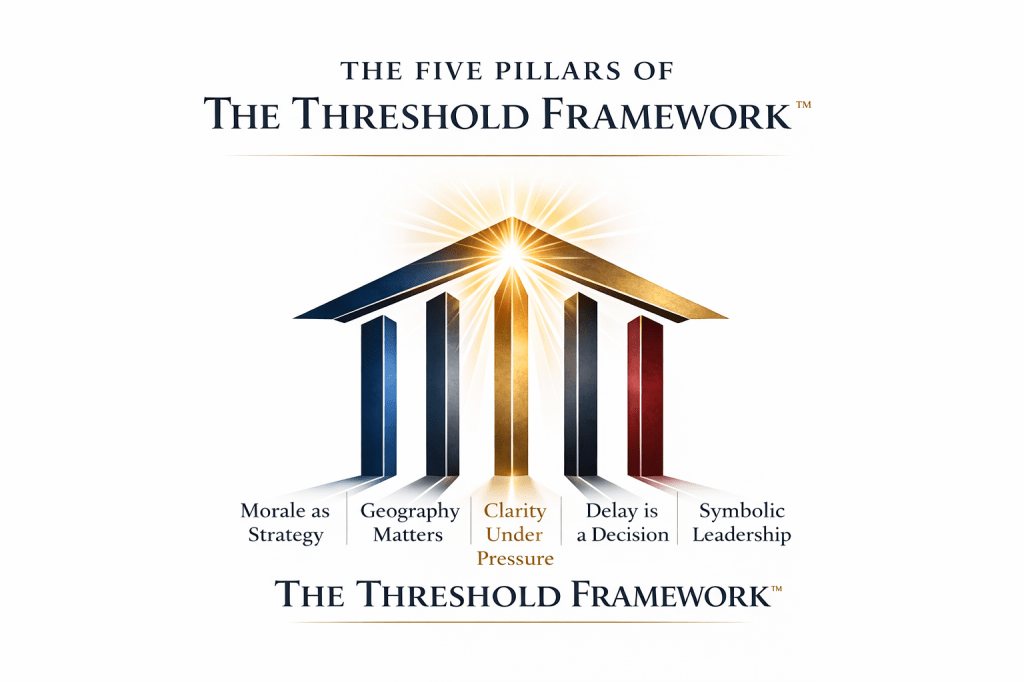
That moment is precisely what The Threshold Framework™ seeks to understand.
Developed through my research into General George Washington’s leadership during the six-day encampment at Gulph Mills in December 1777, The Threshold Framework identifies five principles that emerge whenever leaders must make consequential decisions under conditions of uncertainty, incomplete information, competing priorities, and significant personal risk.
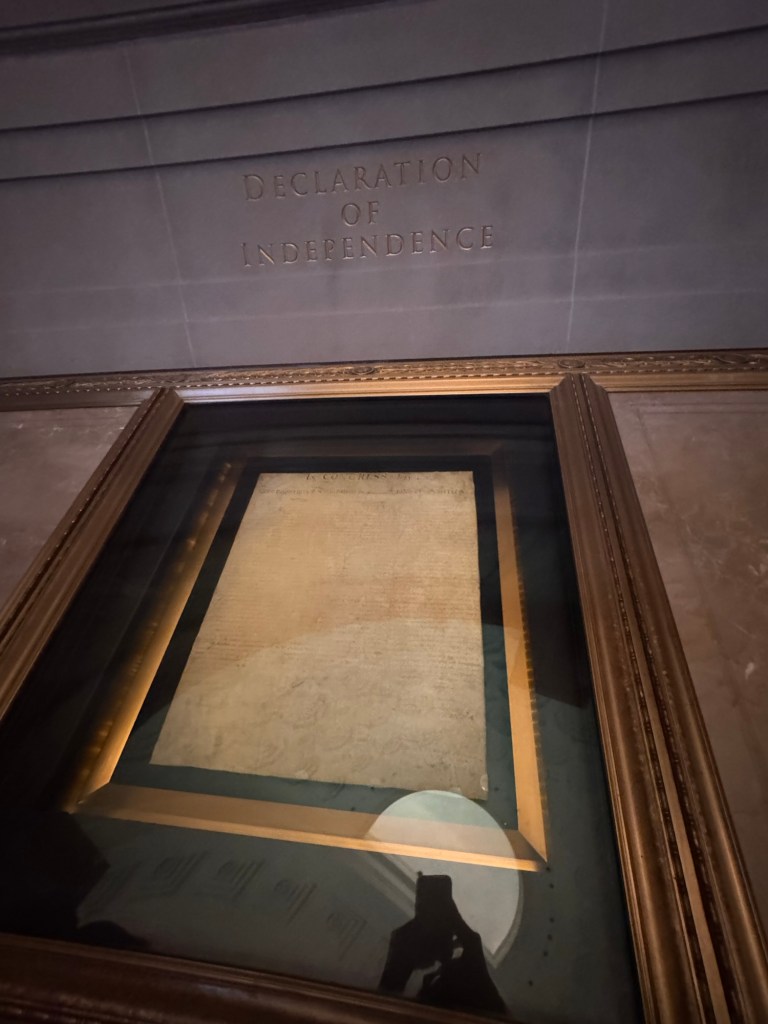
The Declaration of Independence illustrates every one of those principles. I had the honor of attending a special program at the National Archives today where I was able to see an original copy of The Declaration of Independence and hear it read by reenactors. What a thrill.
Pillar I: Clarity Under Pressure
Define what must not fail.
By the summer of 1776, the delegates faced enormous disagreement.
Many feared war with the most powerful empire on earth.
Others worried about economic collapse.
Some questioned whether independence was even achievable.
Yet beneath those disagreements, one essential question became unmistakably clear:
Would Americans govern themselves, or would they continue to be governed without meaningful representation?
The Declaration did not answer every political question.
It answered the one that mattered most.
Exceptional leadership begins by identifying the issue that cannot remain unresolved.
The Continental Congress understood that clarity precedes courage.
Pillar II: Morale as Strategy
Emotional leadership is operational leadership.
Military victories alone do not sustain revolutions.
People do.
The Declaration served as far more than a legal document.
It became a source of shared purpose.
Its opening paragraphs established universal principles.
Its closing paragraphs demanded personal sacrifice.
Between those two sections, Americans found something essential:
A reason to endure.
Washington would later spend years preserving the Continental Army through defeats, shortages, disease, and brutal winters.
But those soldiers marched because the Declaration had already given meaning to their sacrifices.
Morale became strategy.
Purpose became endurance.
Leadership inspired perseverance before it inspired victory.
Pillar III: Delay Is a Decision
In June and July 1776, Congress understood that postponement carried consequences.
Waiting would not preserve peace.
Delay would simply allow events to overtake leadership.
The delegates debated extensively.
They revised language.
They negotiated differences.
But eventually, leadership required choosing.
The Declaration reminds modern executives that refusing to decide is itself a decision—with strategic consequences.
History rarely rewards perpetual hesitation.
Pillar IV: Geography Matters
Every leadership decision occurs within a specific environment.
Philadelphia was more than the meeting place of the Continental Congress.
It stood at the political, commercial, and intellectual center of colonial America.
The delegates understood their geography.
They recognized both opportunity and vulnerability.
Within months, British forces would occupy Philadelphia.
Congress would flee.
Government would become mobile.
Yet the Declaration had already accomplished something geography could not erase.
Ideas can outlast occupations.
Organizations today must similarly understand the environments in which they compete.
Markets.
Communities.
Politics.
Culture.
Technology.
Leadership never operates in a vacuum.
Pillar V: Symbolic Leadership
Leadership communicates through symbols long before policies produce results.
The Declaration became the defining symbol of American independence.
Its words announced more than political separation.
They announced national identity.
The signatures mattered.
The public reading mattered.
The act itself mattered.
Every leader sends signals through actions.
Employees, customers, investors, students, and citizens often remember symbolic decisions long after they forget operational details.
The delegates understood that symbolism shapes commitment.
Crossing the Threshold
Perhaps the greatest lesson of July 4, 1776, is that transformational leadership rarely begins after certainty arrives.
It begins when leaders decide that their values require action despite uncertainty.
The delegates possessed no guarantee of success.
They had no assurance that France would become an ally.
No certainty that Washington could sustain an army.
No confidence that the colonies would remain united.
Many would lose homes.
Businesses.
Families.
Fortunes.
Some would lose their lives.
Yet they understood that history occasionally presents moments from which there is no honorable retreat.
Those are threshold moments.
Why This Matters Today
Although separated by 250 years, today’s leaders confront remarkably similar challenges.
Corporate executives must decide whether to enter emerging markets before complete information exists.
University presidents must navigate crises while preserving institutional trust.
Law firm managing partners must respond to ethical challenges that define organizational culture.
Public officials must balance competing responsibilities under intense scrutiny.
Boards of directors must make decisions that affect thousands of employees and millions of dollars.
The circumstances differ.
The leadership challenge does not.
Every consequential decision asks the same questions:
What must not fail?
How will this decision affect morale?
What are the costs of waiting?
How does our environment shape our choices?
What message will this decision send?
Those questions form the foundation of The Threshold Framework™.
America at 250
As the United States commemorates the 250th anniversary of the Declaration of Independence, we have an opportunity to look beyond celebration toward leadership.
The Declaration was not inevitable.
It was the product of disciplined thinking, principled debate, calculated risk, and courageous decision-making.
It reminds us that freedom itself was born not from certainty, but from leaders willing to cross a threshold together.
That lesson remains as relevant in today’s boardrooms, courtrooms, campuses, nonprofits, and government offices as it was inside Independence Hall on July 4, 1776.
Leadership begins at the threshold.
History remembers those who have the courage to cross it.
Leadership Lessons for Today
Modern executives, university presidents, nonprofit leaders, military officers, elected officials, attorneys, and entrepreneurs rarely face the possibility of execution for treason.
But they regularly face threshold decisions.
Should we merge?
Should we disclose?
Should we litigate?
Should we restructure?
Should we close?
Should we launch?
Should we speak?
Should we act now, or wait?
The Threshold Framework offers the same questions the Continental Congress answered on July 4:
- What must not fail?
- How will this decision affect morale?
- Are we delaying because delay truly helps, or because we fear deciding?
- How does our environment shape this decision?
- What message will our decision send beyond its immediate outcome?
These questions transform leadership from reaction into intention.
Same Ground, 250 Years Later
The July 4 signing of the Declaration of Independence happened in Philadelphia, at the Pennsylvania State House we now call Independence Hall.
A few blocks away stands the site of the President’s House, where George Washington later lived while he led the new nation.
This Monday, July 6, I return to that same ground.
I am joining Dr. Cheryl LaRoche, the historical archaeologist who served on the team that excavated the President’s House, and featured speaker Blondell Reynolds-Brown, former Philadelphia City Councilwoman At Large and author of Walking a Tightrope Backward in High Heels, for Same Ground: The President’s House, Valley Forge, and the Question of Whose Story Gets Told.
The conversation picks up where the July 4 vote leaves off.
The delegates declared the colonies free and independent States. Eighteen months later, the free Black people and enslaved Africans in Washington’s ranks marched through Gulph Mills toward Valley Forge, serving a freedom that did not yet include them all.
Same city. Same founding. Same ground.
The year the country turns 250, this is the conversation that puts the whole story in one room. I hope you will join us.
Same Ground: The President’s House, Valley Forge, and the Question of Whose Story Gets Told Monday, July 6, 2026 | 5 to 8 PM The Fashion District (Love Lab), 932 Market Street, Philadelphia Reception at 5 PM, program at 6 PM, book signing to follow. Free and open to the public.



Leave a comment