 Rebel Hill and Gulph Mills
This blog post is in honor of the Gulph Mills Encampment–the six days in December that General George Washington and the Continental Army spent in my home, Rebel Hill in Gulph Mills, Pa., starting on this day in 1777. I am commemorating that by posting a blog for each of the six days. I first started writing about the Gulph Mills Encampent in my mini-ebook, Six Days in December: General George Washington’s and the Continental Army’s Encampment on Rebel Hill, December 13 – 19, 1777, which was a prequel to my novel, Becoming Valley Forge. Both are available on Amazon or on my author page at The Elevator Group, http://www.theelevatorgroup.com/id33.html.
Now, I have expanded my work on this encampment into a full-length, nonfiction award-winning book titled, Threshold to Valley Forge: The Six Days of the Gulph Mills Encampment.
Late in the evening of December 12, 1777, in a blinding snowstorm, George Washington and his hungry, tired, and barely-clothed army, spent from a December 11 encounter with the British when the Continental Army first tried to cross the Maston’s Ford, started the march from Swedes Ford, in Norristown, to a small farming and mill area called Gulph Mills, the center of which was about five miles away. “We are ordered to march over the river. It snows–I’m sick–eat nothing–no whiskey–no baggage–Lord-Lord-Lord–. Till sunrise crossing the river cold and uncomfortable,” wrote Dr. Albigence Waldo, surgeon to the First Connecticut Infantry Regiment of the Line. [See Albigence Waldo, “Valley Forge, 1777-1778. Diary of Surgeon Albigence Waldo, of the Connecticut Line,” The Pennsylvania Magazine of History and Biography (Philadelphia, PA: Historical Society of Pennsylvania, 1897), 21: 305, http://www.jstor.org/stable/20085750, accessed December 13, 2023.]
Washington’s army spent most of the day on the 13th marching into Gulph Mills from the wee hours of the morning. One soldier wrote, “…at 3 a.m. encamped near the Gulph where we remained without tents or blankets in the midst of a severe snow storm.” [James Mcmichael, “The Diary Of Lieutenant James Mcmichael, Of The Pennsylvania Line, 1776-1778,” The Pennsylvania Magazine of History And Biography (Philadelphia, PA: Historical Society of Pennsylvania, 1892) Xvi: 157.]
Apparently, Washington and many of his generals were the last groups to march in, after some 11,000 soldiers marched in during the day. It is recorded by parishioners that Washington, Lafayette, and other generals saw a light in the Old Swede’s Church on what is now River Road in Swedesburg, right next to the Schuylkill River and the natural route towards Gulph Mills from the Swede’s Ford, as they marched in to Gulph Mills. Washington and his party stopped in the church and saw a group of the many Swedish settlers in Gulph Mills in a St. Lucia Celebration service, which honors St. Lucia, marks the start of the Christmas season, and “is meant to bring hope and light during the darkest time of the year.” Children participate in a pageant where they carry lighted candles and wear them as a crown and bring food and sustenance to their parents. The congregation allowed Washington to speak at the service and, in the process, eight members of the congregation signed up for the Continental Army that day. After service, Washington and his generals continued down the River Road to where they were going to encamp in Gulph Mills. Old Swedes Church re-enacts this visit in a Patriot’s St. Lucia every year on December 13–7 pm this year. [For more information, see this article and video of photos of the celebration in 2010 at https://www.mainlinemedianews.com/2010/12/14/dec-15-video-old-swedes-celebrates-the-patriots-lucia/.]
Several historians believe that Washington was going to make Gulph Mills the Continental Army’s winter headquarters because if he had decided on Valley Forge, it would have been easier to march his tired army straight to Valley Forge, rather than detour them to Gulph Mills, some ten miles away. Some of the letters from members of the army bear that out. Soldier Timothy Pickering wrote, “the great difficulty is to fix a proper station for winter quarters. Nothing else prevents our going into them…it is a point not absolutely determined.”
Because of their elevation of about 400 feet, Rebel Hill and the hills of Gulph Mills, called the Conshohocken Hills, provided an advantageous view for miles around. Those hills were just about the highest in the area. The army could have easily seen the British advancing from Philadelphia to the east, where the British established winter headquarters. Also, Rebel Hill gave the army great access to the Schuylkill River, particularly the crossing points of Matson’s Ford and Swede’s Ford. Finally, Rebel Hill was friendly territory–it got its name because the people who lived there were rebels and patriots supporting the Continental Army. [M. Regina Stiteler Supplee, Gulph Mills and Rebel Hill, Bulletin of the Historical Society of Montgomery County, Norristown, PA, Oct. 1947, Vol. VI,No. 1, p. 17 – 23; https://hsmcpa.org/images/thebulletin/1947vol6no1.pdf; accessed December 13, 2023.]
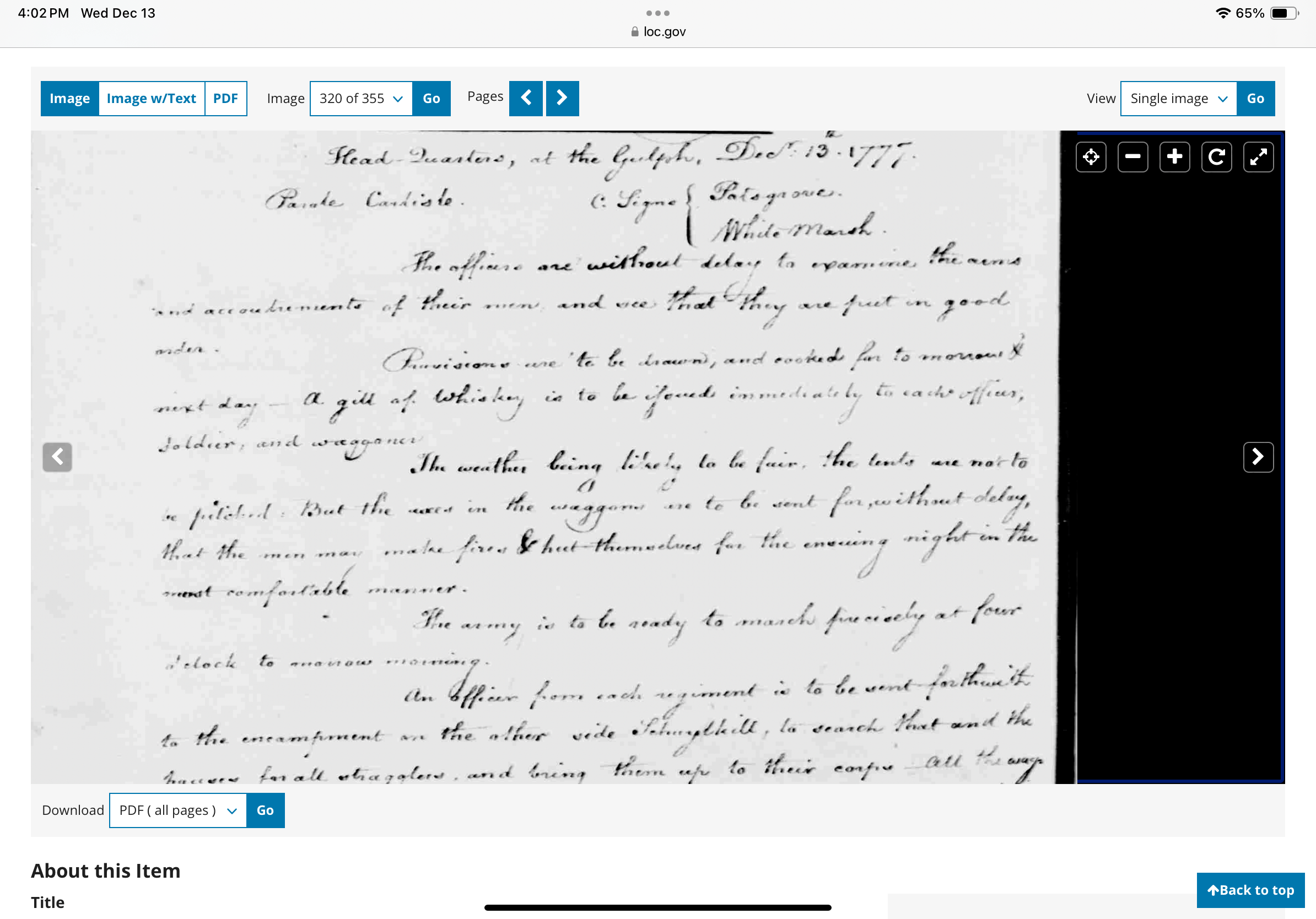
In any event, General Washington had to get his army, which had no tents to shield them from the elements, settled. He issued these orders, his first from Gulph Mills, which he and others also called “the Gulph” or “the Gulf” or “Gulf Mills”.
GENERAL ORDERS December 13, 1777.
Head-Quarters, at the Gulph,
Parole Carlisle. Countersigns Potsgrove, White Marsh.
The officers are without delay to examine the arms and accoutrements of their men, and see that they are put in good order.
Provisions are to be drawn, and cooked for to morrow and next day. A gill of Whiskey is to be issued immediately to each officer, soldier, and waggoner.
The weather being likely to be fair, the tents are not to be pitched. But the axes in the waggons are to be sent for, without delay, that the men may make fires and hut themselves for the ensuing night in the most comfortable manner.
The army is to be ready to march precisely at four o’clock to morrow morning.
An officer from each regiment is to be sent forthwith to the encampment on the other side Schuylkill [author’s note–the encampment at Whitemarsh, which the army had just left], to search that and the houses for all stragglers, and bring them up to their corps. All the waggons not yet over are also to be sent for and got over as soon as possible.
Mr. Archibald Read is appointed paymaster to the 8th. Pennsylvania regiment, and is to be respected as such.
Photo of George Washington’s First General Order from “the Gulph,” Gen. Washington’s Headquarters, Dec. 13, 1777; Library of Congress, George Washington Papers, https://www.loc.gov/resource/mgw3g.002/?sp=320; accessed Dec. 13, 2023.
On to Day 2…
Read about the entire encampment in my article at https://allthingsliberty.com/2019/11/valley-forges-threshold-the-encampment-at-gulph-mills/.
Peace,
Sheilah


Leave a comment